
How should I water my new sod?
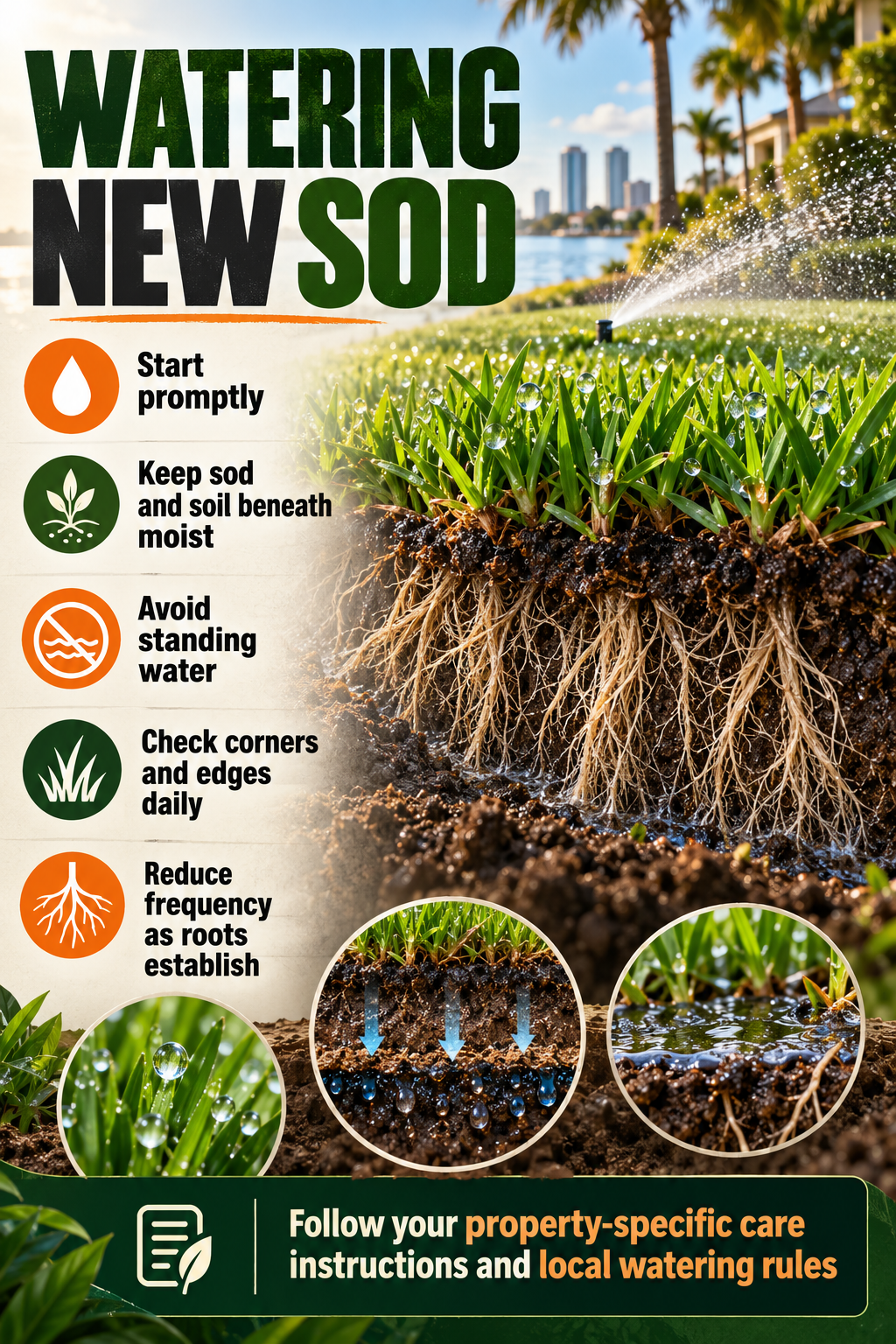
Begin watering promptly after installation. Keep the sod and the soil directly beneath it moist while roots establish. Check several areas daily, especially edges, corners, and locations with weaker sprinkler coverage.
Use the property-specific care instructions reviewed for your installation. Sprinkler output, soil, rain, temperature, and grass variety affect watering duration and frequency. Avoid standing water, runoff, and continuously saturated ground.
As roots establish, gradually reduce watering frequency and transition toward deeper watering suited to the lawn. Contact the office if you see dry edges, persistent pooling, or uneven coverage.
Follow the current new-landscape watering rules for your address and water source. Establishment allowances do not permit unrestricted watering.
Establishment rules differ by jurisdiction and can change during a water shortage. Check the current rules for your address and water source before setting the controller. Do not apply an unincorporated Hillsborough County schedule to a City of Tampa address.
Before installation, make sure someone can carry out the care instructions and check the lawn between scheduled service visits. Do not assume an existing timer setting or a brief sprinkler cycle is appropriate for every part of the new lawn. If you are unsure whether the soil beneath the sod is receiving water, ask for clarification rather than repeatedly increasing the entire system.
When reporting a problem, include photos of the affected area, when the sod was installed, recent rain, and the watering settings you have been using. This gives the office useful context without assuming that every brown or wet patch has the same cause. Irrigation inspection or repair is separate work unless included in your agreement.
City of Tampa watering guidance
Hillsborough County watering guidance
Book an onsite sod consultation online.
Book a sod installation consultation
Related FAQs
