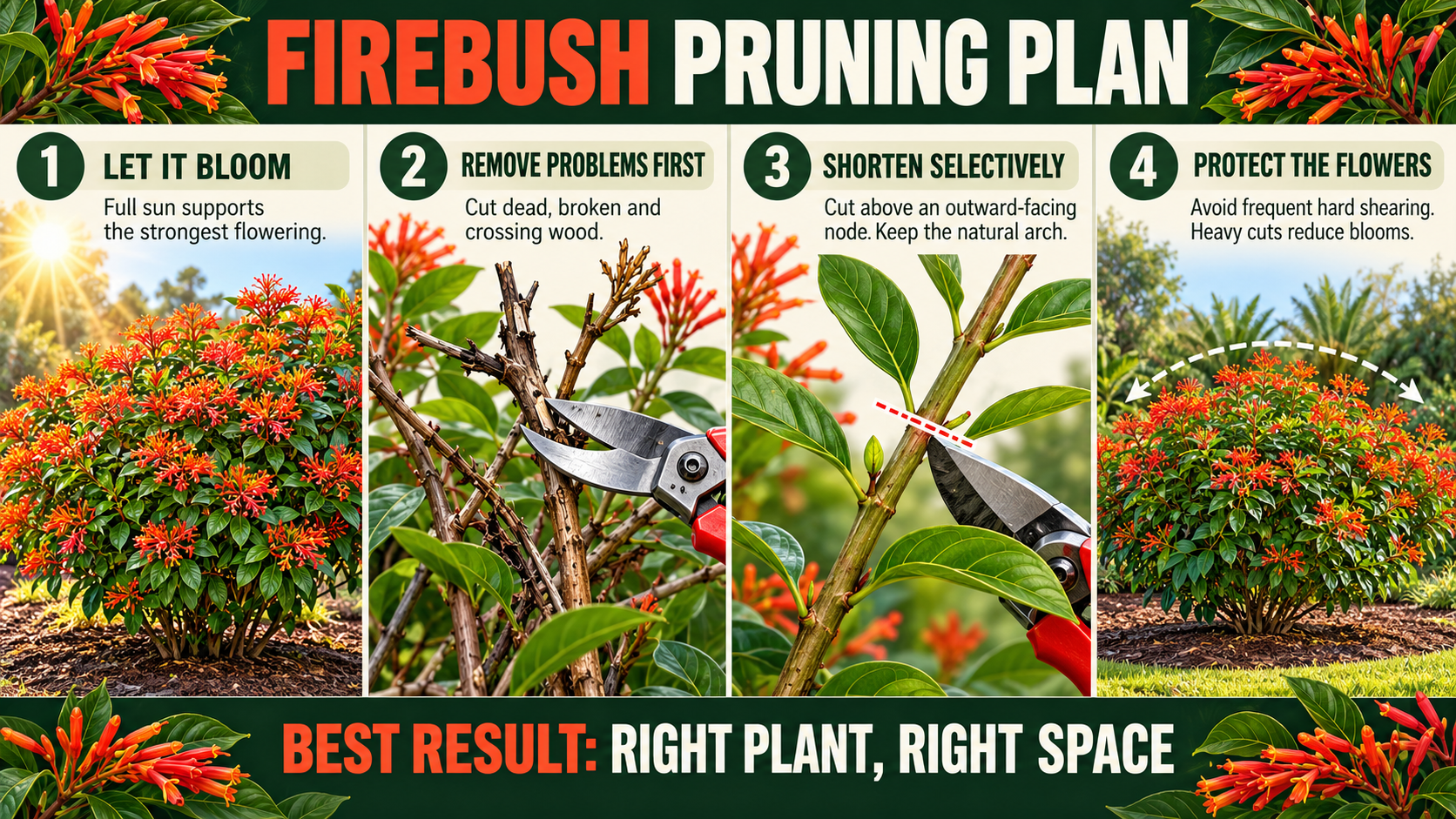
Prune Firebush Without Cutting Away Its Best Blooms
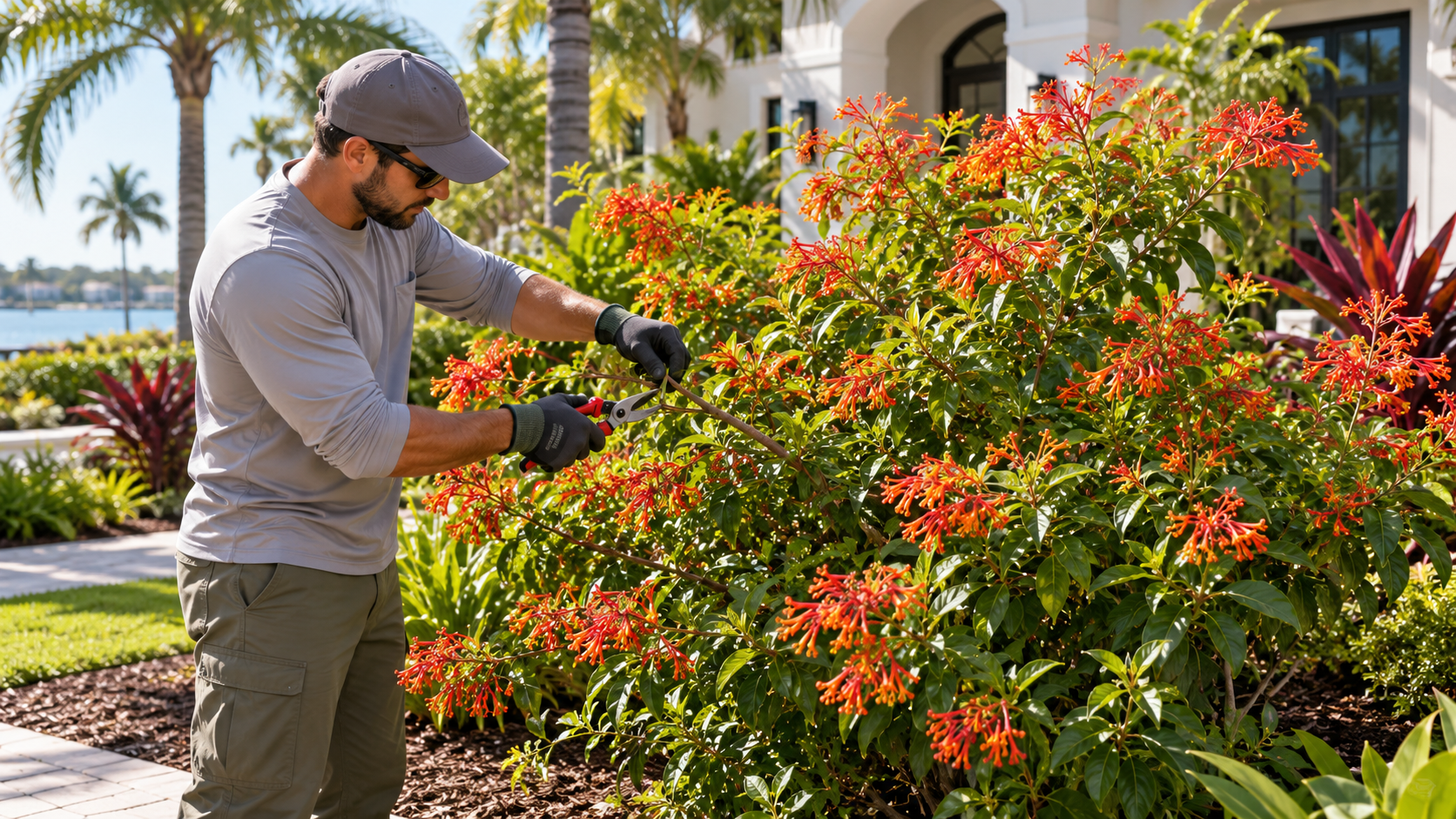
Respect the plant’s natural size
Prune Firebush Without Cutting Away Its Best Blooms by first deciding whether the shrub fits its location. Native firebush, Hamelia patens, grows quickly in warm South Tampa conditions and develops an open, arching form. In a sunny site it produces orange-red tubular flowers followed by dark berries. Repeatedly forcing a large shrub into a tiny space creates constant pruning, fewer flowers, and dense outer growth.
Choose timing around the bloom cycle
Firebush flowers through much of Florida’s warm season. Major reduction removes developing flower clusters and delays the next display. Schedule substantial size correction before vigorous warm-season growth, then use light selective cuts when individual branches interfere with a walk, window, fixture, or neighboring plant. Remove dead, broken, or diseased wood whenever it appears. Avoid heavy pruning immediately before the period when you most want hummingbird and butterfly activity.
Inspect before making cuts
Walk around the entire shrub and identify the longest stems, crossing branches, damaged tips, crowded interior growth, and shoots leaning onto structures. Look beneath the canopy for irrigation tubing, landscape-lighting wire, nesting wildlife, and hidden stems. Decide which few branches will solve the problem. This inspection prevents a rushed surface shearing that removes every flowering tip at the same height.
Make clean selective cuts
Use sharp bypass pruners for small stems and loppers sized for thicker wood. Clean tools before moving between shrubs. Trace an unwanted branch to a healthy side branch or outward-facing node, then cut without leaving a long stub. Stagger reduction cuts throughout the canopy so the plant keeps a natural outline. Remove crossing and inward-growing stems first. Never tear partially cut wood away from the branch.
Avoid repeated hard shearing
Frequent shearing creates a shell of short shoots around a shaded interior. It also removes flower buds across the entire surface. UF/IFAS notes that pruning firebush too hard or too often reduces blooming and recommends keeping standard plants no shorter than roughly five to eight feet. If the available space demands a much smaller shrub, relocation or a smaller plant selection produces a better long-term result.
Support recovery without forcing growth
After pruning, water according to soil moisture and recent rainfall. Keep mulch a few inches away from the main stems. Do not use excess fertilizer to force rapid replacement growth. Watch the cut areas for healthy new shoots and inspect tender growth for pests. A correctly placed firebush in full sun usually needs less intervention and delivers a stronger flower display than one kept under constant size control.
Schedule thoughtful firebush pruning
Ecoscape Outdoor Services will evaluate plant size, sunlight, branch structure, bloom stage, access, and nearby hardscape before pruning. Request service when firebush blocks a walkway, hides lighting, rubs a structure, or needs selective renovation without losing its wildlife value. Helpful reference: UF/IFAS firebush planting and care guidance.